Loose lead walking is one of those skills that sounds simple until you’re being dragged down the street at 7 a.m. with your shoulder taking the strain. You clip the lead on, step out the front door, and within thirty seconds the walk has already turned into a battle of wills before you’ve reached the end of your road. If that sounds familiar, you’re not alone, and more importantly, it is not inevitable.
Walking nicely on a lead is a skill, not a personality trait. Dogs that pull are not naughty, dominant, or untrainable. They pull because pulling has always worked: the walk continued, the smells got closer, and the dog learned that a tight lead is the fastest route to where they want to go. Jack at JanB Dog Behaviourist sees this pattern every week with London clients, and the root cause is rarely what owners expect. Changing that pattern takes the right approach, not more force.
This guide gives you a clear, progressive plan for loose lead training. You will learn how to choose the right equipment, run three short daily exercises that build the skill from scratch, use a distraction ladder to progress safely into busier environments, and fix the most common setbacks: pulling, lunging, and sudden freeze-ups.
Why most dogs pull (and the mistakes that make it worse)
Before jumping into fixes, it helps to understand what is actually happening. Dogs pull because forward movement is the reward. Every time the walk continues while the lead is taut, the dog receives direct confirmation that tension equals progress. This is not stubbornness; it is straightforward learning. Pulling works, so the dog pulls.
The self-rewarding pull cycle
The pull cycle is self-reinforcing by design. The dog pulls, the owner keeps walking, the dog reaches the lamppost or the other dog or the interesting smell, and the behaviour is strengthened. Even owners who occasionally hold firm before giving in are still reinforcing the habit. Intermittent reinforcement makes a behaviour more persistent, not less. When the reward comes unpredictably rather than every time, the habit becomes harder to shift. Giving in after a few seconds of resistance can be worse than never resisting at all.
Common owner mistakes that undo progress
Certain mistakes come up again and again in these sessions. First, using a rear-clip harness on a dog that already pulls hard. These designs allow a strong dog to lean into the chest strap and drive forward without meaningful redirection, which makes it very difficult to interrupt the pattern. Second, reacting to pulling after the fact rather than marking the exact moment the lead slackens. Timing is everything in training, and delayed feedback teaches the dog nothing useful. Third, skipping the foundation steps and heading straight for the park, the equivalent of learning to drive on a motorway. The dog is not ready, the owner is not ready, and the session usually ends in frustration.
Loose lead walking: choosing the right kit before you start
Equipment does not train your dog, but it can make loose lead training significantly easier or harder. Choosing the wrong kit and then trying to teach your dog to walk calmly on the lead is like trying to teach someone to type on a broken keyboard, so get the equipment right before you begin.
What actually helps: front-clip harnesses and headcollars
A front-clip harness is the most practical starting point for most dogs. Because the lead attaches at the chest rather than between the shoulder blades, the dog is gently redirected sideways when they move forward. They cannot drive straight ahead with the same ease, which gives you a window to reward the correct position. For stronger pullers or dogs that have learned to ignore a front-clip harness, a headcollar offers more steering control by directing the head. Headcollars need a gradual introduction with plenty of positive association and must be fitted properly and handled gently, they are not suitable for sharp corrections, as poor technique can place strain on the neck. Used correctly and introduced with patience, both options allow loose lead training to progress without the neck and tracheal pressure caused by a tight collar on a pulling dog.
What to avoid and why
Choke chains, prong collars, slip leads used for corrections, and shock collars apply pressure or pain to stop pulling. They may interrupt the behaviour briefly, but they do not teach the dog what to do instead. In Jack’s experience, and in line with the broader veterinary behaviour literature and guidance from organisations such as Dogs Trust, aversive equipment tends to increase anxiety and, in some dogs, escalates reactivity rather than reducing it. A rear-clip harness is not harmful, but it gives a strong puller a mechanical advantage and is not the right tool for active lead training. Flat collars are fine for dogs that already walk calmly; they are not appropriate as the primary tool for a dog that pulls hard.
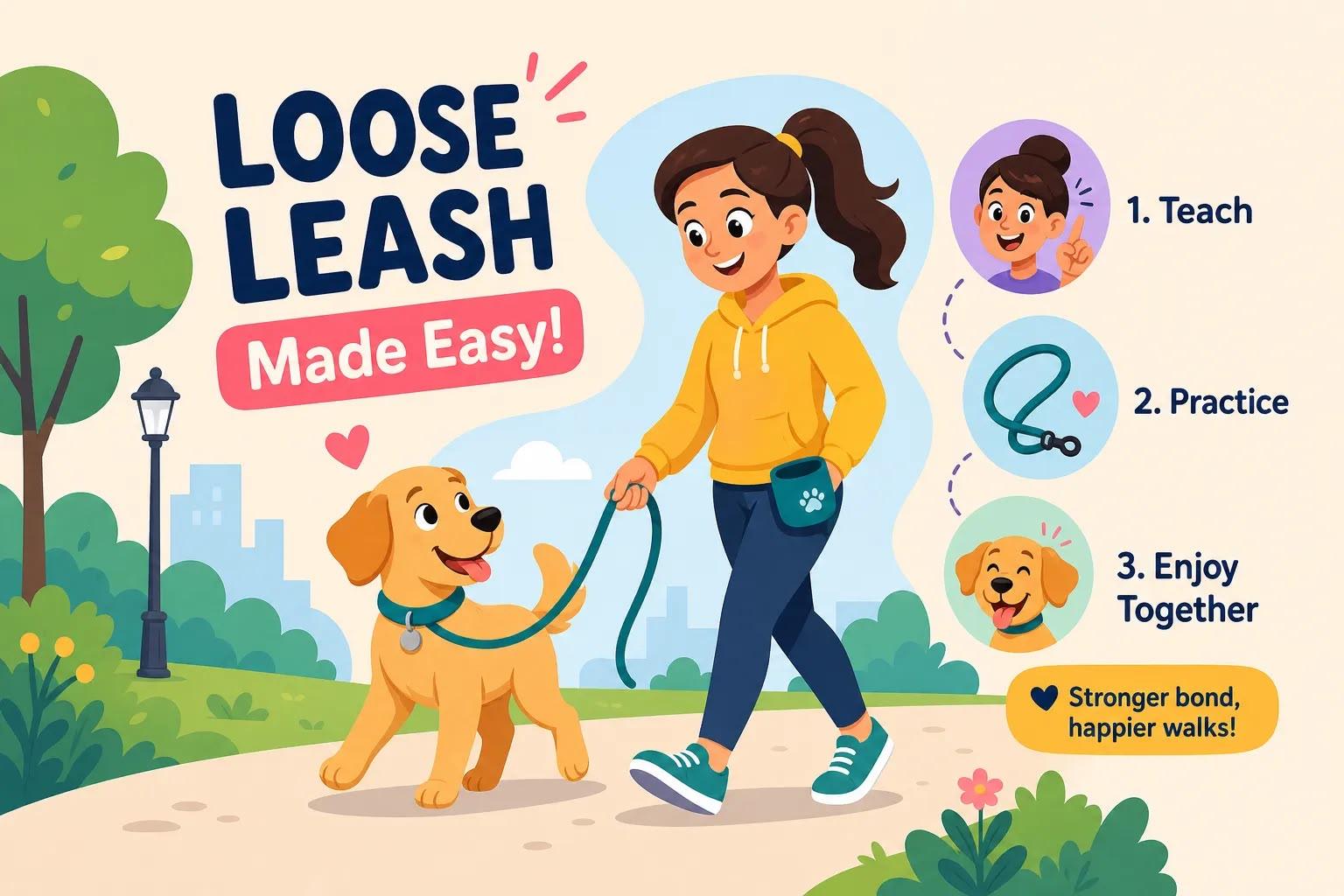
Three loose lead walking exercises to build the skill
These three exercises form a progressive sequence. Each one builds directly on the last, and each session should be no longer than five to ten minutes. Short, frequent practice beats long, exhausting attempts every time. Deliver all food rewards at your leg, not in front of the dog, so the correct position becomes associated with the reward.
Exercise 1: focus and position work indoors
Start with no movement at all. Stand still and reward your dog for choosing to stand or sit calmly beside your leg. This establishes the reward zone: the space next to your thigh is where good things happen. Use continuous reinforcement at this stage, meaning every correct moment earns a treat. High-value food works best here, cooked chicken, cheese, or whatever your dog finds genuinely exciting. Once your dog is voluntarily returning to your side to check in, you are ready to add movement.
Exercise 2: moving steps and direction changes in the garden
Take a few steps and reward your dog the moment the lead is slack. Before the lead tightens, change direction and reward again. The direction changes are not random: they keep your dog watching you rather than fixating on what is ahead. Introduce the stop-and-wait method here. The instant the lead tightens, stop completely. Do not walk, do not pull back, just stop. The moment slack returns, reward immediately and move forward. This is the core rule your dog needs to understand: tension stops progress, a loose lead keeps it going.
Exercise 3: short outdoor sessions with a structured reward schedule
Move outside for five to ten minute sessions in a quiet area, away from high-traffic routes and off-lead dogs. Begin by rewarding every one to two steps on a slack lead, exactly as you did in the garden. As your dog becomes more consistent, gradually shift to rewarding every three to five steps, the move from continuous to intermittent reinforcement that builds reliability without removing the reward entirely. Variable rewards keep your dog engaged because they cannot predict exactly when the treat is coming. That unpredictability makes the behaviour more resistant to distraction over time.
Moving from quiet streets to busy environments
The most common reason loose lead training collapses is jumping too far, too fast. A dog that walks brilliantly in the garden is not automatically ready for the high street. The skill needs to be rebuilt, step by step, at each new level of difficulty.
Building a distraction ladder that actually works
Work through environments in a deliberate sequence: indoors, then the garden, then a quiet residential street, then a park entrance at a quiet time, then an open park, then progressively busier routes. Most dogs need several successful sessions at each level before moving up. When you increase the difficulty of the environment, increase your reinforcement rate again. Going from frequent rewards in the garden to rare rewards on a busy street in one step is a recipe for regression. Treat the new environment as if you are back at the beginning, then thin rewards gradually once your dog is succeeding.
How to handle the environment when things go wrong
Read your dog before the lead goes tight. Watch for the moment their attention locks onto a distraction: the slight stiffening, the ears forward, the pace picking up. That is your cue to act. A cheerful change of direction before your dog reaches threshold is far more effective than waiting until the lunge happens and then trying to manage it. Use distance as your primary tool: moving further from the trigger gives your dog the space to think and respond to you. A U-turn while the dog is still calm is training. A correction after the lunge is damage limitation.
Fixing pulling, lunging, and freeze-ups mid-walk
Even with good preparation, real walks throw up real problems. Here is how to handle the most common ones without undoing your progress.
When your dog pulls toward something
Stop walking immediately. Do not pull back on the lead: pulling back teaches a dog to lean into pressure, which is the opposite of what you want. Stand still and wait. The moment the lead softens, even slightly, reward that moment and then continue. Consistency here is non-negotiable. If you sometimes stop and sometimes keep walking, your dog has no reliable rule to learn from.
When your dog lunges at triggers
Increase distance from the trigger if you can do so before the lunge happens. Use a treat lure and a direction change to move past the distraction while your dog is still calm enough to respond to you. Working below threshold consistently is far more effective than repeated exposure to situations that trigger lunging. Each lunge rehearses the behaviour and raises arousal; each calm pass at a safe distance builds the habit you actually want.
When your dog plants and refuses to move
Do not drag or force forward movement. A dog that freezes is telling you something about how they feel, and applying force can intensify the response. Instead, use a treat lure, take a few backward steps to change the dynamic, or try a direction change to break the freeze. Reward immediately when your dog follows. If freeze-ups happen regularly on certain routes or near certain triggers, that pattern is worth paying attention to: it usually points to anxiety rather than stubbornness.
When training stalls: what a specialist assessment reveals
If you have worked through the steps above consistently for several weeks and your dog is still pulling or struggling, that is not a failure. It is information. It means there is a specific reason that a general guide cannot identify from the outside.
Why some dogs do not respond to standard methods
Several hidden factors can stall progress. Reactivity driven by anxiety rather than excitement looks similar to plain pulling but needs a different approach entirely. A pain response to certain equipment, never identified at the time, can also derail training. Others involve a history of aversive training that has elevated baseline arousal, or breed-specific drive that demands a tailored approach. A Malinois and a Beagle can both pull on the lead, but the reasons and the most effective solutions are often completely different. Applying the same generic steps to both is unlikely to get you far with either.
How a bespoke in-home assessment cuts through the guesswork
This is exactly where JanB Dog Behaviourist comes in. A one-to-one in-home assessment with Jack means your specific dog is observed in their actual environment, on their real walk route, with you as their owner. That context reveals what no online guide can: the precise combination of factors driving the behaviour in your dog’s case. From there, the training plan is built around what that dog actually needs, not what works for dogs in general. To find out whether an assessment is the right fit, get in touch for an initial conversation about what is going on and what the right next step looks like.
The bottom line on loose lead walking
Loose lead walking is achievable for most dogs. The foundation is straightforward: the right equipment, short and consistent sessions, and a gradual progression through environments rather than a jump straight into the deep end. Start indoors, build in the garden, move outside in quiet conditions, and increase difficulty only when your dog is succeeding at the current level.
Most adult dogs show clear improvement within two to four weeks of daily loose lead training. Some take longer, particularly those with a strong history of pulling, high arousal, or underlying anxiety. If your dog is still struggling after several weeks of consistent work, that is useful information: it points to a specific reason rather than a general one, and a specialist can identify it far faster than trial and error.
For owners who want a clear answer, a bespoke assessment with JanB Dog Behaviourist is the natural next step. You will leave with a training plan built around your dog, not around dogs in general, and a much clearer understanding of what has been missing. Get in touch to start that conversation.