Knowing how to train a puppy can feel overwhelming in those first few days, you’ll get advice from your vet, your neighbour, five different websites, and your mum, and most of it will contradict the rest. Sleepless nights, unexpected puddles, and a small dog with apparently zero interest in your house rules are entirely normal. The good news is that this is manageable, and it gets easier faster than you might expect.
What matters most is what happens in those first few weeks. The habits, boundaries, and routines you set now shape the dog your puppy becomes. It’s one of the most common things we hear from owners who come to us for help with an older dog: “I wish I’d known this from the start.” This guide gives you exactly that, what to prioritise, when to do it, and the practical methods that build lasting results from day one.
How to Train a Puppy: What to Sort Out in the First 48 Hours
The decisions you make in the first two days often become permanent habits. Where the puppy sleeps, whether they’re allowed on the sofa, how the family greets them when they arrive home, none of these are small choices. Set clear house rules before your puppy arrives, get everyone in the household on the same page, and stick to them from the moment your puppy walks through the door. Mixed messages in those first days are one of the most consistent causes of confusion and problem behaviour further down the line.
Name recognition is the first real training task, and it’s simpler than most people expect. Say your puppy’s name once in a calm, clear voice, and the moment they look at you, mark it with a word like “yes” and immediately give a small treat. Repeat this in short bursts throughout the day. This simple exercise is the foundation for every command that follows, because a puppy that reliably responds to their name is a puppy you can communicate with. Trust builds through calm, predictable interactions, not through correction or repetition.
A rough training timeline helps you see what’s coming. In the first week or two at home, typically around 7 to 8 weeks old, focus on settling in, name recognition, and getting used to handling. From 8 to 10 weeks, introduce crate training, establish a toilet routine, and begin simple commands like sit. From 10 to 16 weeks, build on those foundations with socialisation, recall practice, and early leash work. Think of the first 16 weeks as laying the groundwork: everything after that is built on what happens now.
The Socialisation Window That Shapes Your Puppy’s Future
Socialisation is often misunderstood as simply introducing your puppy to other dogs. In reality, it’s far broader than that. The goal is to give your puppy positive, controlled exposure to the full range of experiences they’ll encounter in adult life: people of all ages and appearances, household sounds, different floor surfaces, car rides, vet visits, and unfamiliar objects. The sensitive period for socialising your puppy runs roughly from 3 to 16 weeks, with the core window commonly cited as 3 to 12 weeks, and what your puppy experiences during this time has a disproportionate effect on how they respond to the world as an adult.
The most common question new owners ask is how to socialise safely before vaccinations are complete. The answer is not to wait. Missing this window has real, lasting consequences for your dog’s behaviour. Instead, socialise smartly: carry your puppy in busier areas so their paws don’t touch the ground, visit friends with vaccinated and healthy dogs, and expose your puppy to sounds and new environments from a safe distance. Brief, positive exposures matter far more than volume. A short, calm encounter is worth far more than an overwhelming one.
The rule in every new situation is the same: never flood and never force. If your puppy hesitates or pulls back, increase the distance, slow the pace, and use treats and quiet praise to build a positive association. For instance, if a dustbin lorry frightens your puppy, don’t move closer, find a distance where your puppy stays relaxed and can still take a treat, and work from there. One frightening experience during this window can take weeks of patient work to undo, so err on the side of gradual every time.
How to Train a Puppy with House Training: The Routine That Actually Works
Puppy Toilet Training: Setting the Schedule
Consistent scheduling is the heart of effective puppy toilet training, not willpower or punishment. The core pattern is: wake, potty, feed, potty, play, potty, then crate or supervised time. For very young puppies, that cycle repeats every 30 to 60 minutes throughout the day. Puppies this age physically cannot hold their bladder for long periods, and accidents happen when the schedule slips, not because the puppy is being difficult. By around three to four months, most puppies can manage longer gaps, and by four to six months, reliable daytime control is usually in place.
Crate Training a Puppy: Getting It Right from the Start
The crate is one of the most useful tools in toilet training, but only when it’s introduced correctly. Start with the door open and toss a few treats inside, letting your puppy explore at their own pace. Build gradually to short, calm sessions with the door closed before using it overnight. Placing the crate near your bed in the early weeks can significantly reduce nighttime anxiety. The bedtime routine is simple: final toilet break, calm cue, treat into the crate, lights low. Night whining doesn’t always mean your puppy needs the toilet, a puppy settling into a new routine will sometimes simply protest. Listen for persistence and urgency rather than reacting to every sound.
When accidents happen indoors, and they will, don’t punish. Clean the area thoroughly with an enzyme-based cleaner to remove the scent entirely, then revisit your supervision schedule. Puppies can relearn the correct habit quickly once the routine is tightened up. The puppy is not being defiant; the schedule simply needs adjusting.
Teaching the Commands That Matter Most Early On
Short Training Sessions and Positive Reinforcement Training
The most important early commands are sit, recall, and loose-lead walking, each introduced roughly in that order for good reason. Sit is easy to capture and low-arousal, making it ideal for the very first training sessions. Recall is safety-critical and should be introduced early with the highest-value rewards you have. Loose-lead walking comes later because it requires the kind of focus and impulse control that takes a little more time to develop.
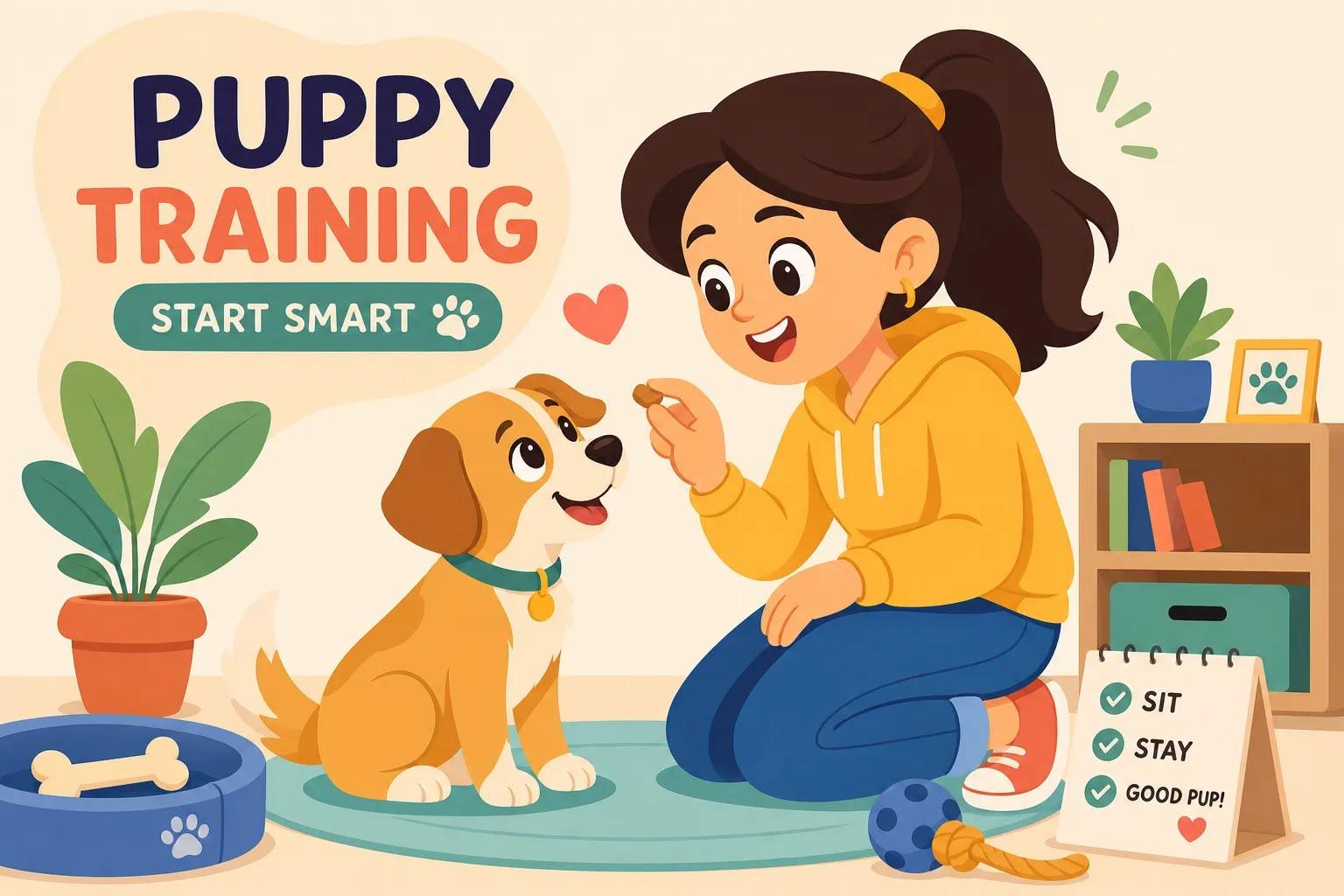
The method that works consistently is positive reinforcement training: mark the exact moment the correct behaviour happens, then reward immediately. A marker word like “yes” or a clicker works well here. Say the word or click the instant your puppy’s bottom touches the floor in a sit, then deliver the treat. That precise timing is what teaches your puppy which behaviour earned the reward.
Use small, soft treats that can be eaten quickly, chicken, cheese, and freeze-dried liver are all excellent choices. For recall specifically, use your very best treats every single time in the early stages, reserving lower-value rewards for calmer, more established commands like sit once they’ve learned it well.
Keep sessions short. For puppies between 8 and 12 weeks old, three to five minutes per session is plenty. Two or three of these spread through the day is significantly more effective than one longer session. Always finish on a success, not a struggle, and your puppy will come back to the next session ready to engage.
Stopping Mouthing and Building Calm, Settled Behaviour
Mouthing is normal puppy behaviour, not aggression. Puppies explore the world with their mouths and use play-biting to interact. The goal is not to suppress this entirely but to teach bite inhibition and redirect onto appropriate outlets. When teeth touch skin, withdraw your attention immediately: turn away, go quiet, and stop engaging. Then offer a suitable chew toy as an alternative. Consistency across the entire household is essential here. If one family member allows the mouthing while everyone else discourages it, progress stalls. The puppy quickly learns to choose their moments.
Building calm, settled behaviour is one of the most overlooked parts of early training, and it pays dividends for years. Introduce a settle routine early by choosing a mat or specific spot, rewarding your puppy calmly for lying there, and very gradually extending the duration. Start with just a few seconds before rewarding, not minutes. Keep your arrivals and departures low-key and calm; the drama you put into leaving or returning directly affects how your puppy feels about being alone. A puppy that learns to settle independently early is far less likely to develop separation-related problems later on.
When You Need More Than a General Guide
Generic advice covers the essentials, but every puppy is different. Breed, temperament, household setup, and your daily routine all affect what works and what doesn’t. Owners who follow guides carefully but still struggle are often missing one or two specific variables that a trained eye can identify quickly. Getting tailored support early is far more effective than waiting until problems become deeply ingrained patterns that take considerably longer to unpick.
The difference between a group class or an online resource and a one-to-one in-home session is significant. When a specialist visits your home, they see exactly how your puppy behaves in the environment where the training actually has to work. They can identify what’s inadvertently reinforcing the wrong behaviours and build a plan around your specific routines, your home layout, and your family’s dynamics. This is precisely what JanB Dog Behaviourist offers: personalised one-to-one puppy consultations conducted in your home, tailored to your individual puppy and household rather than a onesize-fits-all programme. There’s also a free initial call to talk through your situation with no pressure and no obligation, so you can find out straightaway whether it’s the right fit.
Getting It Right from the Start
Most owners find the first 16 weeks go faster than expected, and the habits that stick are the ones started early and kept consistent. Learning how to train a puppy well isn’t about doing everything perfectly; it’s about setting the right foundations before the window closes. Start with clear boundaries and a reliable toilet routine, use the socialisation period wisely, keep command sessions short and reward-based, and build calm behaviour a little at a time. The effort you put in during these early weeks pays off in your dog’s long-term behaviour and welfare.
If you want personalised help on how to train a puppy in your own home rather than more generic advice to sift through, a one-to-one consultation with a specialist gives you a clear, tailored plan to follow with confidence. Get in touch with JanB Dog Behaviourist to book a free initial call and find out exactly where to start.
If you’re looking for quality puppy training near me in London, don’t hesitate to reach out to JanB Dog Training to help you set your puppy on the path to success. Contact us at 020 3603 1789 or Contact@janb.co.uk to schedule a consultation. Let’s work together to build a well-behaved, happy, and confident dog!